

流体音に関する研究(Research on aeroacoustics)
サブテーマ(Sub-themes)
■流体音響連成解析による流体機械における騒音発生機構の解明(Elucidation of noise generation mechanisms in fluid machinery using direct aeroacoustic simulations)
■非定常アジョイント手法を用いた流体音の革新的制御技術の創出(Development of innovative aeroacoustic noise control techniques using an unsteady adjoint method)
■複雑流動場の音響リモートセンシング技術の開発(Advancement of acoustic remote sensing technologies for complex flow fields)
研究概要(Research summary)
家電や車両などの機器には、居住環境の快適性の観点から低騒音化が求められています。これらの機器から発生する騒音のうち、流体の運動に起因する流体騒音は、一般に発生メカニズムが複雑であるため、対策が困難とされています。本研究では、数値シミュレーションを活用して、流体騒音の発生メカニズムの解明および低減技術の開発に取り組んでいます。さらに、流体機械の性能評価や状態監視の効率化を目的として、流体音の計測データから流動状態を推定する技術の開発にも取り組んでいます。
Devices such as home appliances and vehicles are expected to operate quietly to ensure a comfortable living environment. Among the various types of noise emitted by these devices, aerodynamic noise is particularly difficult to suppress due to the complexity of its generation mechanisms. This study employs numerical simulations to elucidate the mechanisms of aerodynamic noise generation and to develop effective noise reduction strategies. Furthermore, to enhance the efficiency of performance evaluation and condition monitoring of fluid machinery, we also focus on developing techniques to estimate flow states from acoustic signals.
流体音響解析(Aeroacoustic simulation)
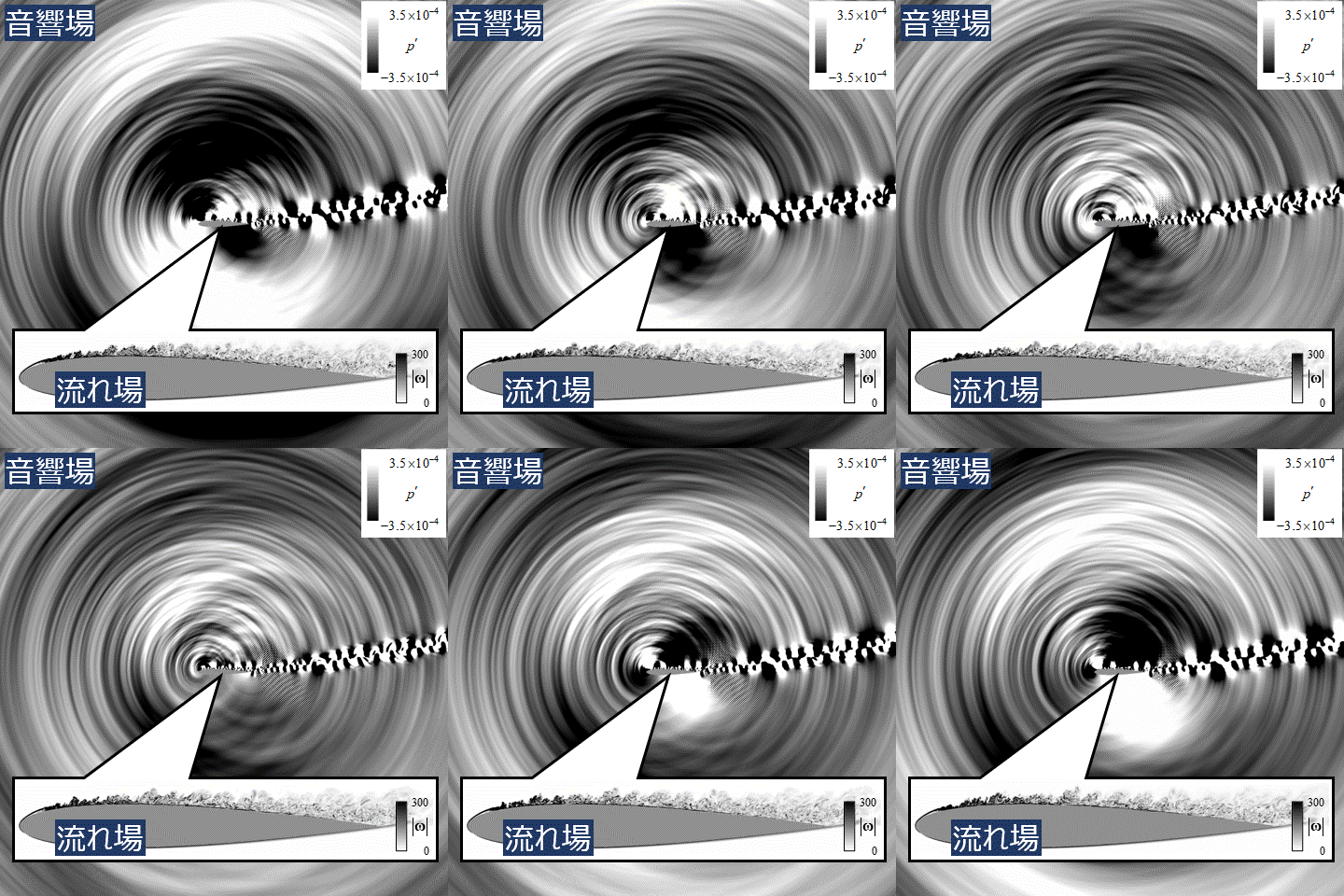
機械工学では、空調機に搭載される各種のファンや自動車の車体まわりの流れのように主にマッハ数が小さい流れから発生する流体騒音が課題となります。本研究では、低マッハ数流れを対象に、格子ボルツマン法(LBM)を用いた流れ場と音響場の連成解析技術の開発に取り組んでいます。特に、ターボ機械の動翼のような流線形状の移動物体をLBMで効率的に計算するために、直交格子と物体適合格子を組み合わせたハイブリッド格子を用いた計算手法を開発しています。さらに、騒音低減に良く使用される吸音材をモデル化することで、流体音の発生・伝播・吸収の過程の一貫解析を実現しています。
In mechanical engineering, aerodynamic noise generated by low-Mach-number flows—such as those around fans in air conditioning systems or the exterior surfaces of automobiles—poses a significant challenge. This study aims to develop a direct aeroacoustic simulation method for such flows using the lattice Boltzmann method (LBM) [Ref]. To efficiently simulate moving bodies with streamlined geometries, such as rotor blades in turbomachinery, we are developing a computational technique that combines Cartesian and body-fitted grids within the LBM framework. Furthermore, by modeling sound-absorbing materials commonly used for noise reduction, the proposed approach enables comprehensive analysis of the generation, propagation, and absorption of aerodynamic noise [Ref].
 |
 |
 |
|---|---|---|
| 単独翼から発生する乱流音の直接計算 Direct simulation of broadband sound from an isolated airfoil [Ref] |
プロペラファンの翼端渦の3次元構造の可視化 Flow structure of the tip vortex in a propeller fan [Ref] |
垂直軸風車のLBM解析 LBM simulation of a vertical-axis wind turbine |
 |
 |
 |
|---|---|---|
| 直交・物体適合ハイブリッド格子を用いたLBMによる横流ファンの解析 Simulation of a cross-flow fan using a hybrid grid combining Cartesian and body-fitted grids in the LBM framework [Ref] |
||
Direct simulation of broadband sound from an isolated airfoil [Ref]
Flow structure of the tip vortex in a propeller fan [Ref]
LBM simulation of a vertical-axis wind turbine
Simulation of a cross-flow fan using a hybrid grid combining Cartesian and body-fitted grids in the LBM framework [Ref]
流体音響最適化(Aeroacoustic optimization)
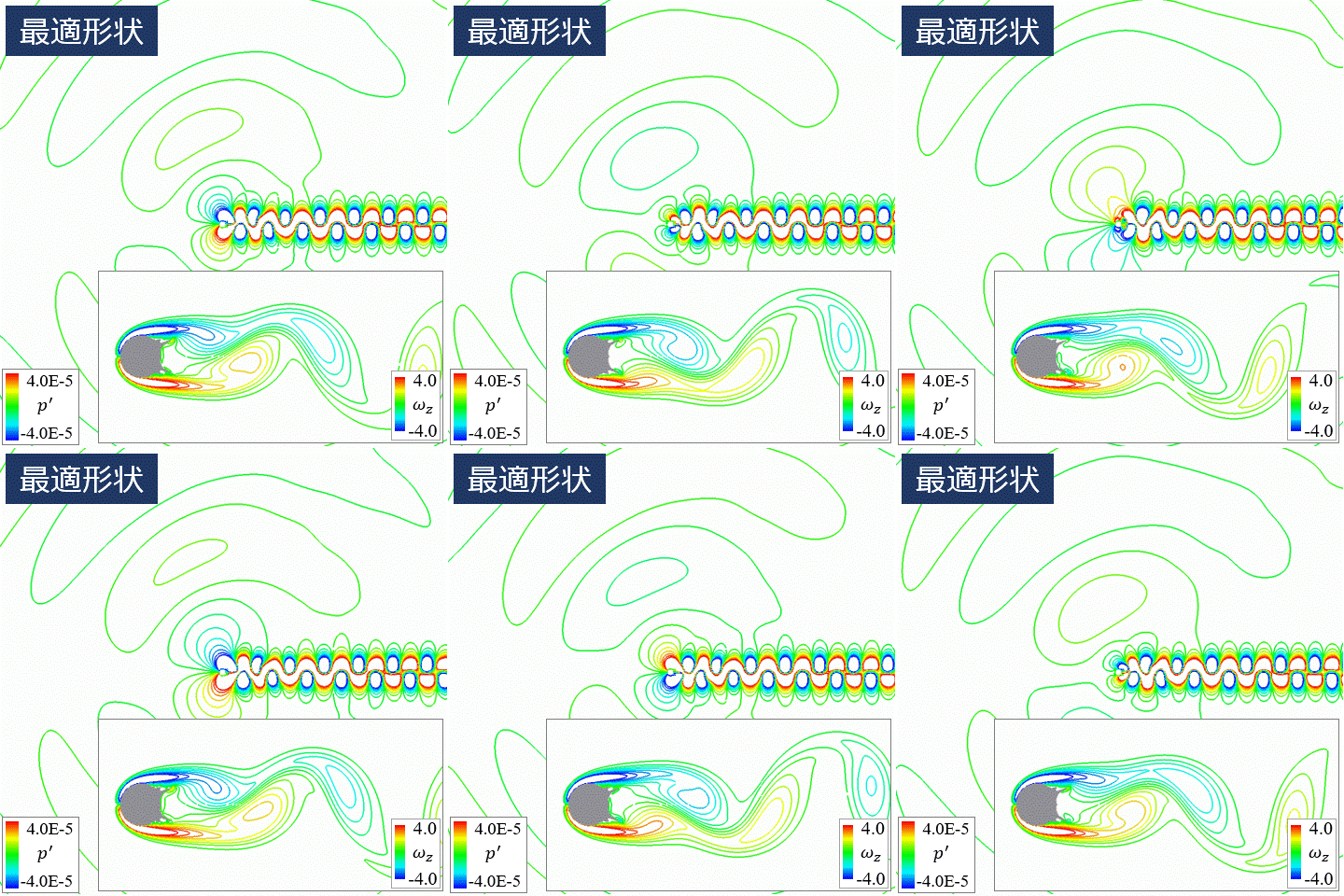
近年、数値解析技術の進展により、機器設計の段階で流体騒音を予測したり、音源を同定することが可能になりつつあります。しかしながら、こうした順解析のみでは、流体音の発生をどのように抑制すべきかといった設計指針を直接的に導くことは困難です。本研究では、流体音響問題を対象として、格子ボルツマン方程式に基づく随伴法(アジョイント法)を用いた逆解析手法を構築しています。この手法により、流体騒音の低減に資する革新的な形状を効率的に導出できることが期待されます。実際に、本手法をエオルス音やキャビティ音といった代表的な流体音に適用し、新たな受動制御技術の提案を行っています。
In recent years, advances in numerical analysis techniques have increasingly enabled the prediction of aerodynamic noise and the identification of its sources during the design stage of mechanical systems. However, forward analysis alone does not directly yield design guidelines for effectively suppressing aerodynamic noise. In this study, we develop an inverse analysis method for aeroacoustic problems based on the adjoint lattice Boltzmann method (LBM) [Ref]. This approach is expected to facilitate the efficient derivation of innovative geometries that contribute to noise reduction. The proposed method has been applied to representative cases of flow-induced noise, such as aeolian tones and cavity tones, leading to the development of novel passive control strategies.
 |
 |
|---|
 |
 |
|---|
Control of aelian tones using an adjoint method: the top shows the initial shape, and the bottom shows the optimized shape [Ref]
Control of cavity tones using an adjoint method: the top shows the initial shape, and the bottom shows the optimized shape [Ref]
流動場の音響リモートセンシング(Acoustic remote sensing of flow fields)
流体機械の性能評価や状態監視においては、流れ場内の速度や圧力などの物理量を直接計測することが本来望まれます。しかし、暴風や高温といった過酷な環境条件、あるいは可動部の存在により、直接計測が困難となるケースも少なくありません。加えて、多数のセンサを設置することは、コストの増加や流れ場の擾乱といった新たな課題を引き起こす可能性があります。そこで本研究では、遠方に設置した音圧センサで取得した音響データから、音源となる非定常流動場の情報を抽出することで、低コストかつ非侵襲的に流動情報を取得する手法の確立を目指しています。具体的には、4次元変分法に基づくデータ同化手法や機械学習技術を活用し、音響データに基づいて流れ場を逆推定する解析手法の開発に取り組んでいます。
In the performance evaluation and condition monitoring of fluid machinery, it is ideally desirable to directly measure physical quantities such as velocity and pressure within the flow field. However, direct measurements are often difficult due to harsh environmental conditions—such as strong winds or high temperatures—or the presence of moving components. Moreover, installing a large number of sensors can lead to increased costs and may disturb the flow field itself. To address these challenges, this study aims to establish a low-cost and non-intrusive method for acquiring flow information by extracting characteristics of unsteady flow fields—the sources of sound—from acoustic data obtained via remotely placed pressure sensors. Specifically, we are developing an inverse analysis technique that reconstructs flow fields from acoustic measurements using data assimilation based on four-dimensional variational (4D-Var) methods and machine learning approaches.
 |
 |
|---|---|
| 音響情報に基づく流動場の逆解析の構想 Concept for inverse analysis of flow fields based on acoustic information |
音響情報から非定常流体力を推定する機械学習モデル Machine learning model for estimating unsteady fluid forces from acoustic information |
Concept for inverse analysis of flow fields based on acoustic information
Machine learning model for estimating unsteady fluid forces from acoustic information